Sunday, July 6, 2014

SA Diversity Tour (18-21/03/2014) Day 62-65

Kgalagadi Transfrontier Park
We were very excited about going to Kgalagadi Transfrontier Park and left Upington very early to make the 3 hour drive there. I had not been there for about 20 years and remembered it as a terrific place to be. At the time of making the booking, we could only get camping at Twee Rivieren but when we arrived, we were told there is place at Mata Mata and we gladly changed some of our first days for it. 
 
 
What a huge disappointment!! According to their website, most of the roads are said to be accessible to vehicles like mine but they were so bad that we had to drive not more than 20km/ph and so bumpy, it took us hours to get there. About the only thing we saw along the way was a lion laying hidden by some bushes, a few Gemsbok and some Wildebeest.
 Mata Mata itself is totally run down although it looks like they are building a new ablution block. They had some rain there a week before we arrived and when we went to ask, were told their grader was not working and they did not know when they would fix the roads again. Typical darn government owned place!!
We once again changed our bookings for Twee Rivieren as the roads there had not been as bad as further north. SO the next morning, back down we went!! After three very bad days where we were basically restricted to going only to the first watering hole about 5kms away, we went to ask them if they could change our booking to some other camp such as Augrabies, Addo or Mountain Zebra as it did not us much good not being able to go anywhere. We were not very politely told that they could not and that if we wanted to leave, we would lose the money we had paid for the other 4 days we were going to stay!! When I questioned the conditions of the roads and mentioned that it said vehicles like mine could go on them, I was told that their website now said 4x4 vehicles only!! Even the people there WITH 4x4’s were complaining!! So my advice is: DO NOT GO TO KGALAGADI!!
The only thing worth seeing at Mata Mata was the Yellow Mongoose digging for food in the camping area. The rest of the area was a total waste of time!


Wednesday, July 2, 2014

SA Diversity Tour (16-17/03/2014) Day 60-61

 Prieska - Uppington
Leaving Mountain Zebra and going to Upington on our way to Khalagadi Transfrontier Park, we passed through the small town of Prieska and found this beautiful miniature prickly pear along the road. As beautiful as it looks, it is unfortunately and invasive species.
We stayed for two days at the caravan park in Upington trying to catch up on our computer work and the first night had a very dramatic sunset.
It was nice to just laze around for a while and got to do the shopping for food we needed to take with us to Kgalagadi where there are no nearby shops.

Thursday, June 12, 2014

Cradle of Humankind SA - Part 3

These were behind glass and I had to use the camera's flash - please excuse the glare of it in the photographs.
Our world was born in a ball of burning gas 4.6-billion years ago, in a universe that is about 14-billion years old. Over time it cooled, the early atmosphere formed, and the first land masses appeared.
The first life forms, which were like the black algae you sometimes see in swimming pools today, emerged about 3.8-billion years ago.
The history of life on Earth has been rocked by five major extinctions. The last great extinction was 65-million years ago, when the dinosaurs were wiped out, probably after a giant meteor slammed into the Earth off the coast of Mexico, and set off volcanic eruptions all over the world, changing the global climate. Today, some scientists say we are in the midst of the sixth major extinction – and its cause is us.
We know about species which have populated our Earth before us by studying fossils. Fossils are the remains of plants or animals which have been turned into stone over a long period of time in a process known as “mineralisation”.
Charles Darwin, an English naturalist, was one of the first people to express a theory of evolution – the idea that species change over time, as they adapt to changing environments.

Sunday, June 8, 2014

SA Diversity Tour (11-15/03/2014) Day 55-59

 Mountain Zebra National Park
The rising of the sun sees us riding around looking for what this day will bring and the Springbok and Red Hartebeest are a good start.
Even though it is late summer, many of the flowers are just starting to bloom and the patches of the Karoo Blue Tulip is a beautiful sight to see amongst the drying grass.
This is the first time I have ever seen a Shelduck so was pleased to add it to my knowledge base.
In this region, the aloes start to bloom in their vibrant orange and red colours like this Snake Aloe.
Springbok play in the grassland while it is still cool in the mornings.
These flowers were amazing – it is a creeper and found all over the Park. Right now it is blooming profusely and looks so delightful.
An Agama lizard comes out to warm up in the sunlight. They are about 25cm (10”) in length. The females are not very colourful.
Poor Zebra! He looked so dejected with his one ear hanging so floppily. I had to feel sorry for him. J
A female Brown Button spider is much larger than the male. If he is not careful, she will kill him and preserve him to feed to her babies.
All over the ride through the mountains I found this bush with its bright yellow and lilac coloration. They belong to the Sweetpea family.
 This large moth looks like it might make a great carpet does it not? So soft and furry. LOL!!
This is an unknown species of flower to me - one of the Iris family. They are small and the stems are about 40cm (14”) in height.

Wednesday, June 4, 2014

SA Diversity Tour (5-10/03/2014) Day 49-54

 Addo Elephant National Park
We spend a night in Kirkwood and went on to Addo Elephant National Park. This is our second visit there and we looked forward to the week we were going to spend there. Click here to see my previous post on the accommodation etc
We are eager to get into the Park as we loved it here last time. The shadows were still long when we went past one of our favourite watering holes but not much was stirring.
A Black-backed Jackal is scarcely visible in the light and it looks as though he might have found something to eat in the long grass.
A yellow Aloe lends a bit of bright colour to the drying vegetation.
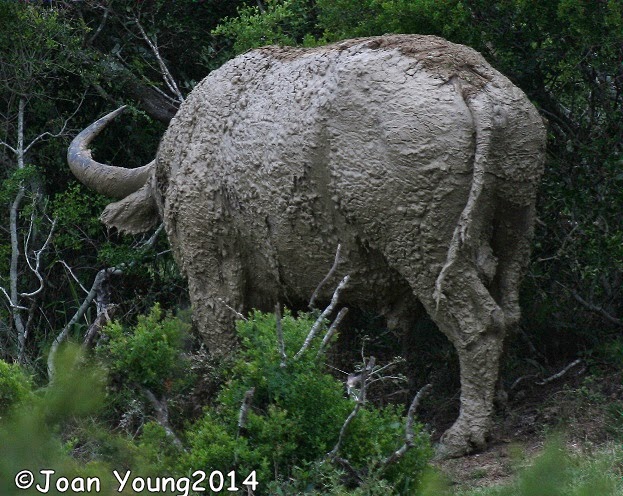
We came across this Buffalo which had just got out of a mud hole. He is surely the dirtiest one I have ever seen. LOL!!
A Fiscal Shrike is hanging about on a branch waiting for it to warm up so that the butterflies and insects can come out.
This very large tortoise made me smile – it looked like he was pretending to be a rock while sleeping and hoping that no one would notice him. J
Bush Violets are small and lovely. They make a lovely show.
Laying on the side of the road was a lioness with a radio collar on. Many of the animals in the Park have them as the place is surrounded by human inhabitants and the collars will give them an indication if any get out of the boundaries.
The elephants are just the most beautiful I have come across. They are placid and calm and totally unlike those in Kruger National Park. The one day while we were parked by the watering hole, a youngish elephant came and gently put his trunk against the back of my car and I could not understand why. It was only when we got back to camp the we saw what attracted him. There were some very ripe bananas in the back which he was smelling. J
Zebra snails are as huge as my hand and this was a first time for me to see this species also. I just love going to these regions which I do not know and have not been able to get to in order to find things like this.
I do not know what this bush is called but it looks like some kind of Euphorbia. These low bushes were covered with magnificent yellow flowers.
A Boomslang had been ridden over on the road. They are one of our deadliest snakes and if a bite is not treated soon and correctly, death can occur.
Red Hartebeest are a medium-large antelope and fairly common in our National Parks.
The top highlight of our stay there for me was seeing this Rock Monitor. I have seen pretty large ones up to 2m (6’) in length but this one was about 1.5 times as large and the same girth as a crocodile. I have NEVER seen one so large!! A truly fantastic sight to see. I wonder how old it is?

Friday, May 30, 2014

SA Diversity Tour (3-4/03/2014) Day 47-48

Warmwaterberg Spa
For our visit to Warmwaterberg Spa, Gaelyn and I each had our different ideas of what we wanted to do there.
For me the main attraction was finding what plants, animals etc were found there and the beautiful walks but for her, the idea of relaxing in the Roman Bath and the wonderful Malva Pudding she had there last year.
Warmwaterberg Spa is a mineral hot spring situated between Barrydale and Ladismith on Route 62 from Montagu to Oudtshoorn.
The Spa is set on a 600Ha property and offers self-catering accommodation for those who wish to do-it-themselves, but also has a full-service licensed restaurant, bar and off-sales for those who want to indulge.

 A small kiosk supplies basic necessities, including braai-wood and ice alongside a selection of groceries.

 The main attraction is our unique hot water (44°C at the source). It is very high in iron content, making it extremely healthy and sweet-tasting. Many visitors claim to experience a soothing and calming effect after bathing in the water, which is completely untreated and fresh from the artesian spring.

In addition to the two hot pools, there is a cold pool and a number of roman baths (imagine “bath” for up to six people!) on the property.
 Think of it this way: at the kiosk you will pay a small amount for 500ml of bottled mineral water. Here you can step into a freshly-tapped roman bath containing 1000 litres of (many say superior) mineral water and bath in it! Try some of our specially-formulated bath salts to further enhance the experience.
 The other great attraction of the Spa is its location – set high up on the foothills of the Warmwaterberg Mountain, you will enjoy panoramic views over the little Karoo, clear from the Langeberg to the Swartberg. Barren and desolate to some, but to those with a little knowledge of the Succulent Plant Kingdom, unrivalled in specie numbers, diversity and beauty on any of the five continents!
Enjoy these special plants from close-up along our spectacular 6km walking trail on the edge of the mountain, and see how many of the over-2000 endemic species you can identify! The best season to see them in flower is spring, but this depends on winter rainfall. If we have a good season, they are spectacular!
  If you time your walk for the early evening or at daybreak you might just bump into Springbok, Duiker or Steenbok who also make the property their home.

For more information and pictures as well as contact details, please go to: http://www.warmwaterbergspa.co.za/